Meat Pie Game - A Postmortem

Play the game here!
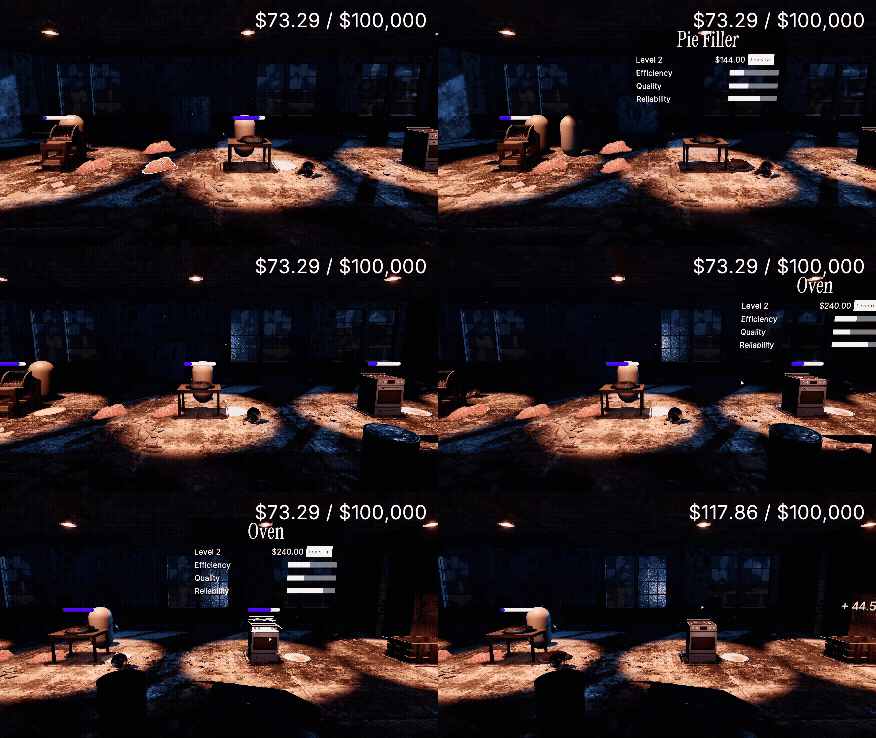
Meat Pie Game is an incremental atmospheric horror game made in five months in Unity. As I am, and aspire to be, a systems designer, Meat Pie Game was intended to be a showcase of my systems design skills - particularly economy and progression. Additionally, after the long development of Aw, Shoot! I wanted to keep this game's scope small. Meat Pie Game is, by a number of metrics, some intrinsic and others extrinsic, my most successful game.

To start with the quantifiable (as it's both shorter and less interesting), it's been played more than any other of my games by a significant margin. As you can see, between downloads and browser plays, the game was played about 170 times, and the page was viewed 315 times. My next most popular game, New Cat, topped out at 59 plays and 286 views, so we can call Meat Pie Game a rousing, if relative, success. My next most popular and the biggest albatross around my neck is Aw, Shoot! with a scant 48 plays and 121 views (which, compounded with the year-and-a-half development time, especially stings). But now is not the time to relitigate past grievances. It's a time for celebration! These numbers are certainly not Steam-New & Trending-worthy, but for the scale I'm working in, and without any promotion or social media following, I'm satisfied.
With the boring numbers out of the way, onto the fun numbers: Excel spreadsheets and exponential pricing curves! As previously mentioned, my main objective with Meat Pie Game was to highlight my economy and progression systems design skills. The new tools I incorporated to this end were Excel spreadsheets (in actuality, I used Google Sheets, but Excel is a useful shorthand) to track the stats of each station at each level, and exponential curves to create a smooth progression in the economy. Neither implementation was especially complex, but I'm now much more comfortable using them, and I'm excited to put them to good use on more sophisticated projects in the future.

Pictured above is the stat sheet for the meat grinder station as an example. At the base level, the meat grinder will have an efficiency of 0.1, a quality of 0.1, and a reliability of 0.6. At level two, an efficiency of 0.35, and so on and so on. I tried to chart out some curves on Desmos that I could port into the spreadsheet, but I found that these hand-picked values worked much better for the experience I was going for. Not only that, but it would be tiresome to get equations that represent each stat for each station, as they all operate differently. For example, the reliability of the meat grinder here takes a dip in level 3. By the time the player has reached level 3, they're pretty used to just immediately purchasing an upgrade as soon as it's available, so I wanted to introduce some more complexity to that, and with reliability being the most directly impactful stat to the player experience (as it creates the annoying and distracting station breaks), it was the natural place to do it.
The economy balancing was more straightforward in implementation, but required just as much thought in the design. Game economy affects just about everything in most games, but few more so than the incremental game. The rate at which the player accrues currency completely dictates both the pace and length of the game, and with the small scope and short playtime I was aiming for with Meat Pie Game, it was important that I got it right. Given that the game takes about 15 - 20 minutes to beat—exactly the time I was hoping for— I would say that I did! The key here was being generous to the player. Part of the intent with the stations was to make them feel tedious to use so that the player is incentivized to purchase workers. Making any element of a game intentionally frictional is a big (and potentially ill-advised) risk, so I wanted to make sure the player doesn't spend too long with the worst iteration of each machine and without any workers. By the end of development, I had probably tripled the rate at which players earn money, and the game is all the better for it.

One thing that became clear in the first few playtests was that the real fun of the game was in hiring and managing the workers. They were always part of the experience, but were initially implemented as a mid/late-game reward for having done so much manual work up to that point. This approach made for some excruciating playtests, as players clearly weren't super interested in the first half of the game after the tutorial. However, once they hired their first worker, they would light up. From that point on, I knew I not only had to get the player working with the workers as soon as possible, but also that I should create different choices for them to make when interacting with them.
The workers have 3 stats: years of experience, work experience, and a "like." The years of experience basically translate to the worker's level. The higher the number, the faster they move. This is perhaps not directly analogous to the real world, but I allowed myself some creative liberties with the system. The work experience dictates which station they excel at, but it does not mean that they can't be assigned to other stations. A baker can work as a filler, but is best used on the oven so that they can hit the sweet spot every time. The "like" was initially more of a joke than a distinct mechanic. A bit of flavor to heighten the tone of the game and give some character to the workers. The dissonance between the eerie tone of the warehouse and the childlike simplicity of someone liking partying is the kind of humor I appreciate in games. Upon further deliberation, though, I thought that it could add some more depth to the late-game experience. Once the player has hired all of the workers they can, there isn't too much for them to do besides upgrade to the next level of worker at each station. With the "likes," the player can actually hire two workers that like the same thing and assign them to neighboring stations to provide a minor stat boost to both workers. This isn't by any means a necessary strategy to beat the game, but I enjoyed adding some hidden depth to an already interesting mechanic.
As previously stated, keeping the scope small was foundational to my approach with Meat Pie Game. Part of that principle was not putting in too much effort where I didn't feel motivated to. As you can probably tell from looking at the game, I am not particularly passionate about UI design. I certainly see its value, but I find it a bit of a chore to implement, especially when there are more gameplay-affecting areas I could work on. I felt like I spent 40% of the dev time on Aw, Shoot! making sure that the various UI elements were all legible and pretty, and it was a lot of effort that I wasn't looking to repeat. The first version of the UI here was particularly rough, but after some prodding from other devs and playtesters, I gave it another pass, which included updating the fonts to something a bit more flattering. The game is better for it, and I begrudgingly appreciate the notes, even if it still doesn't look particularly impressive. The silver lining to this lack of effort is that I was able to redirect it to the actual visuals of the game, which I am very proud of.

The game pretty clearly uses a hodgepodge of free and paid Unity Asset Store models and assets, which, if we're being generous, is my ode to games like Getting Over It and Betrayal at Club Low. As I am not a skilled modeller, this was an intentional decision that allowed me to focus on other aspects of the visual design—particularly the lighting and intro cinematic. The dramatic, stage-play-inspired lighting was part of the game's visual identity from the start. It's easy to implement, it's eye-catching, and it provides clarity to the gameplay. What wasn't always part of the plan was the intro cinematic; something I hadn't done previously. I love both arthouse and grindhouse films, and with the lighting and setting placing the game somewhere between the two, I wanted to set the tone with a bit more flair than I usually do. Equal Parts The Cook, the Thief, His Wife & Her Lover and The Texas Chain Saw Massacre. Additionally, I needed an efficient way to explain the win condition of the game without being too straightforward about it. I am really, really, really pleased with how the cutscene turned out. The text was actually the hardest part to nail down, as both communicating the proper information and preserving the atmosphere are difficult to do when working with such little real estate.
There is plenty I didn't get to implement (a more dramatic ending, a small cutscene that plays for every worker hired, etc.), but I am exceedingly pleased with where it stands currently. It's a testament to both my game systems design skills and rigorous approach to solo game development.
Comments